

Shanxi Taiyuan edible powder negative pressure dilute phase conveying general contracting project
In the expansion project of an edible powder processing company in Shanxi, the original manual handling and mechanical lifting methods can no longer keep up with the production pace. During material transfer, not only does it generate a large amount of dust, but contact with air also leads to a decline in quality; At the same time, frequent equipment failures and high energy consumption have become major obstacles to capacity improvement. Companies urgently need a conveying solution that can achieve sealed, efficient, and low-loss delivery to meet the hygiene requirements and capacity targets of the food industry.
Core pain points for customers

The challenges faced by the company focus on three aspects: first, traditional conveying methods cause material loss rates as high as about 3%, directly increasing costs; Second, open operations led to excessive dust concentrations in the workshop environment, which did not comply with food production hygiene standards; Third, when switching between multiple varieties or small batches, cleaning the original equipment is time-consuming and easy to mix, seriously affecting production efficiency.
Targeted solution: negative pressure dilute-phase pneumatic conveying system
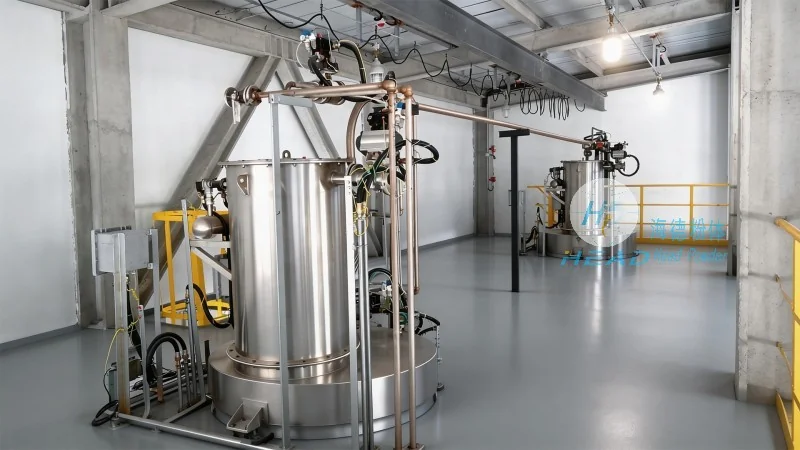
Head Powder provided this customer with a negative pressure dilute-phase pneumatic conveying system. The system uses a negative pressure suction principle to transport edible powder to the workstation through sealed pipelines, ensuring no dust overflow throughout. The dilute phase conveying mode operates at a lower airflow velocity and material-gas ratio, effectively reducing material crushing and pipeline wear, while working with an automated control system to achieve multi-channel material distribution and relatively accurate measurement. Given the dry climate and powder dispersion in Shanxi, the system is equipped with anti-static and explosion-proof components to ensure safe operation.
Solution implementation and results

After the project was implemented, workshop dust concentration dropped by over 90%, material loss was controlled within 0.5%, overall conveying efficiency increased by 40%, and pipeline cleaning time when switching types was shortened to under 15 minutes. After one year of operation, maintenance costs are only 60% of those of traditional mechanical conveying, earning unanimous recognition from the customer's production department.