

Pneumatic delivery solution for powder powder
In the pharmaceutical industry, the delivery of medicinal powder often faces challenges such as dust swirling, material moisture, cross-contamination, and low production efficiency. Different powders have significant differences in physical and chemical properties, such as fine particle size, strong hygroscopicity, easy oxidation, or tendency to electrostatic. These characteristics directly limit the applicability and safety of traditional mechanical conveying methods. Head Powder is deeply engaged in powder engineering, offering customized pneumatic conveying system solutions tailored to the specific needs of powder conveying, balancing sealing, cleanliness, and reliability.
Customer pain points
Traditional medicinal powder delivery methods have the following prominent issues:
1. Dust Dispersion: Open conveying causes powder to float, polluting the workshop environment and endangering operator health.
2. Material Loss: During transportation, powder spillage and adhesion cause waste, increasing production costs.
3. Risk of cross-contamination: Switching between multiple varieties is difficult to clean, and residual powder may cause inter-batch contamination.
4. Low conveying efficiency: Manual handling or simple machinery is limited by distance and height, making it difficult to meet the requirements of continuous production.
5. Equipment wear and clogging: Some powder powders are highly viscous and prone to clumping, resulting in poor operational reliability of conventional equipment.
Material characteristics

The characteristics of the powder material are the core basis for conveying scheme design:
- Particle size distribution: mostly micron-sized fine powders, easily suspended and agglomerated.
- Density and stack angle: lightweight materials require lower conveying velocities to prevent dust; Heavy materials require sufficient kinetic energy.
- Hygroscopicity: Some powders are prone to deliquescence and caking in humid environments, affecting flowability.
- Flammability and explosiveness: For example, certain extracts from traditional Chinese medicine or chemical active ingredient dust pose an explosion risk.
- Hygiene requirements: Must comply with GMP standards, no metal foreign matter mixed in, and the inner wall of the pipe must be smooth and easy to clean.
Product Introduction
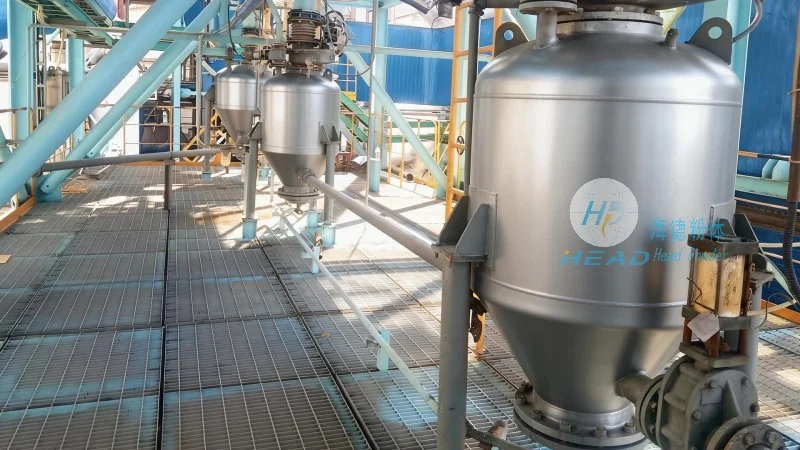
Head Powder designs and manufactures pneumatic conveying system equipment based on the specific characteristics and production process of the powder. This solution uses an air source drive to deliver powder from the supply point to multiple target locations through a sealed pipeline, enabling either positive or negative pressure conveying to suit different working conditions. The core components of the system include: feeders (such as rotary valves, venturi tubes), delivery pipelines, air source handling units, separators (such as cyclone separation or bag dust collectors), electronic control systems, and monitoring instruments. The company offers one-stop services from solution demonstration, process design, equipment manufacturing to on-site integration and commissioning, helping the system seamlessly integrate with existing production lines.
Product advantages

To address the above customer pain points, Head Powder's pneumatic powder conveying solution offers the following solutions:
- Fully enclosed conveying: The pipeline system is well sealed, preventing dust leakage, maintaining a clean production environment, and reducing material loss.
- Explosion-proof and safety design: Measures such as inerting, explosion relief, and grounding are configured according to the material's explosion level to meet dust explosion-proof safety standards.
- Clean and easy to clean: The inner wall of the pipe is smoothly treated and can be equipped with automatic cleaning or quick-open structures, suitable for quick switching between multiple types and reducing the risk of cross-contamination.
- Relatively accurate control and automation: By adjusting air flow rate, pressure, and conveying speed through variable frequency control, combined with PLC and host computer monitoring, it achieves quantitative and scheduled conveying, improving production cycle times and stability.
- Customized matching: Optimizing pipeline route, elbow radius, and feeder selection based on material flowability, particle size, humidity, and other characteristics to effectively prevent blockages and wear and extend equipment lifespan.