

Case Study of Positive Pressure Pneumatic Conveying of Lithium Salt Inorganic Salt Powder in Liupan
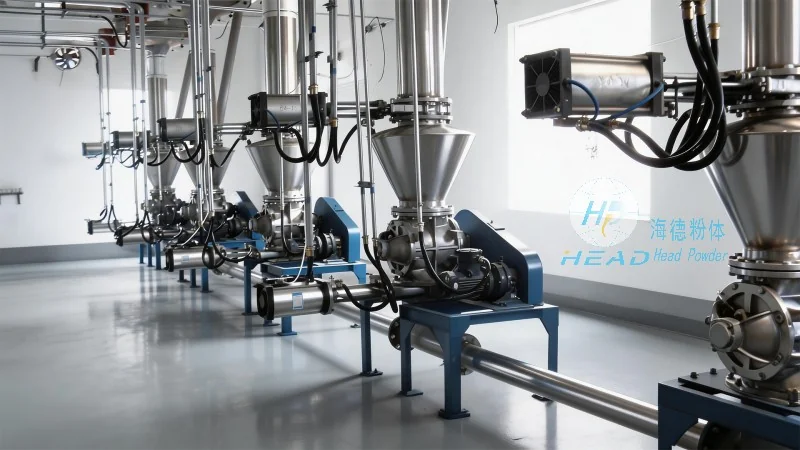
At a lithium salt production enterprise in Liupanshui, Guizhou, the powder transportation stage has long faced challenges such as dust dispersion, pipeline blockages, high labor costs, and significant material loss. The company mainly deals in lithium salts and inorganic salt powders. The original mechanical conveying method is not only inefficient but also fails to meet environmental protection and clean production requirements. To address this, Head Powder has customized a positive pressure pneumatic conveying system for them, achieving fully enclosed and automated operation from feeding and conveying to storage.
Customer pain points

The company encountered the following core pain points during powder transportation:
- Severe dust pollution: The open conveying process causes large amounts of lithium salt dust to escape, affecting the workshop environment and employee health;
- Frequent pipeline blockages: Materials have strong adhesion and uneven particle sizes, making traditional negative pressure conveying more prone to blockages, and shutdown cleaning is time-consuming and labor-intensive;
- Low production efficiency: There are many manual feeding and transfer steps, unable to meet the demand for capacity expansion;
- High material loss: Dust and residues during mechanical conveying cause about 3%~5% material loss.
Head Powder Solutions

To address these pain points, Head Powder has designed and implemented a positive pressure pneumatic conveying system, with main advantages including:
- Fully sealed pipeline transportation: Uses positive pressure dense phase conveying technology, allowing materials to flow at low speed and high concentration inside the sealed pipeline, preventing dust leakage from the source and meeting environmental protection standards;
- Anti-clogging optimized design: Customized pipe diameter, elbow angle, and gas replenishment device based on the physical properties of lithium salt powder, reducing the probability of blockage and improving the stability of continuous system operation;
- Intelligent control integration: Equipped with a PLC automatic control system to achieve relatively accurate adjustment of conveying pressure, flow, and speed, supporting remote monitoring and fault alarms to reduce manual intervention;
- Energy-saving and low-consumption operation: Compared to traditional dilute phase conveying, positive pressure dense phase conveying reduces air consumption by about 30%, while also minimizing material breakage and wear, thereby protecting product quality.
After the project was implemented, the dust concentration in the company's workshop dropped to within industry standards, conveying efficiency improved by nearly 40%, material loss dropped below 1%, and overall operation and maintenance costs decreased. This system has been operating normally for over two years and has become one of the reference cases for powder conveying in the local lithium salt industry.