

Pneumatic conveying solution for activated carbon powder
In industries such as environmental protection, chemicals, food, and pharmaceuticals, activated carbon powder is widely used as an adsorbent, decolorizing agent, or catalyst. However, in actual production, many companies face the following challenges:
- Traditional manual feeding or mechanical conveying methods cause severe dust emissions, harsh working environments, and occupational health risks.
- Activated carbon powder is lightweight, fine-grained, and easily agglomerates, leading to blockages in transportation pipelines, frequent equipment downtime for maintenance, and affecting production efficiency.
- During conveying, the material breakage rate is high, the fine powder content increases, affecting subsequent process efficiency and causing raw material waste.
- Insufficient system sealing makes activated carbon prone to moisture and oxidation, leading to performance degradation and unstable product quality.
These pain points directly restrict the realization of continuous and automated production lines and increase enterprise operating costs.
Material characteristics: Analysis of the difficulties in conveying activated carbon powder
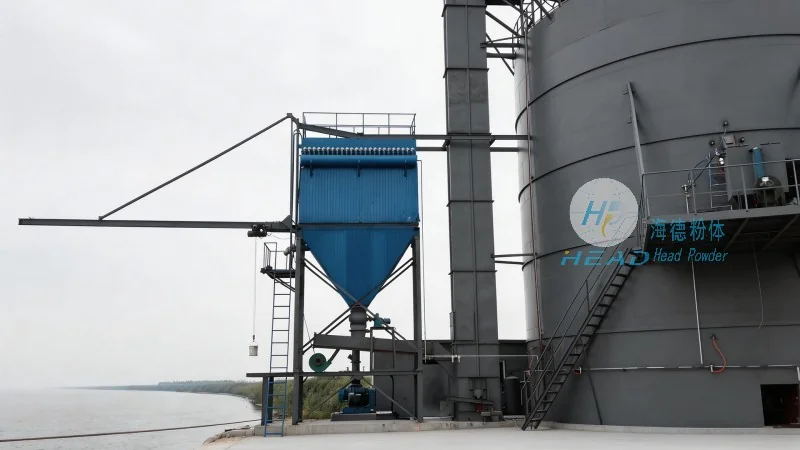
Activated carbon powder exhibits the following typical physical and chemical properties, which determine that its conveying process requires targeted design:
- Low density and poor flowability: Bulk density is usually 0.3~0.6 g/cm³, with high friction between particles, making it difficult to discharge evenly under gravity.
- High fine-grain content: Average particle size between 10~100 microns, prone to electrostatic adsorption and agglomeration, leading to bridging or blockage.
- Strong moisture absorption: The porous structure makes activated carbon easily absorb moisture from the air, and after clumping, its fluidity deteriorates further.
- Abrasiveness and fragility coexistAlthough the hardness is not high, long-term conveying may still cause pipeline wear, and the particles are easily broken to produce more fine powder.
Based on these characteristics, conventional screw conveying or bucket lifting cannot meet the requirements of sealed, low-break, and continuously stable processes, making pneumatic conveying a more reasonable solution.
Product Introduction: Activated carbon powder pneumatic conveying system equipment

Head Powder's pneumatic activated carbon powder conveying solution is a complete equipment system developed to address the above pain points and material characteristics. The system uses positive or negative pressure pneumatic conveying principles, powered by compressed air or fans, and transports activated carbon powder from storage to feeding point through sealed pipelines. The entire process is completed in a sealed environment with no dust leakage.
Core equipment includes: pneumatic sending tanks (silo pumps), rotary feeders, Roots blowers/air compressors, dehumidification and filtration units, piping assemblies, and PLC automatic control systems. The system can be modularly customized according to user process conditions (conveying distance, height, conveying capacity, site layout, etc.), adapting to new production lines or retrofitting old lines.
Our company has extensive experience in pneumatic conveying of activated carbon powder, capable of providing full-process services from solution design, equipment manufacturing, installation and commissioning to subsequent operation and maintenance for materials with different mesh sizes (such as 200 mesh, 325 mesh), different humidity, and different adsorption activity requirements.
Product advantages: Solutions that address customer pain points
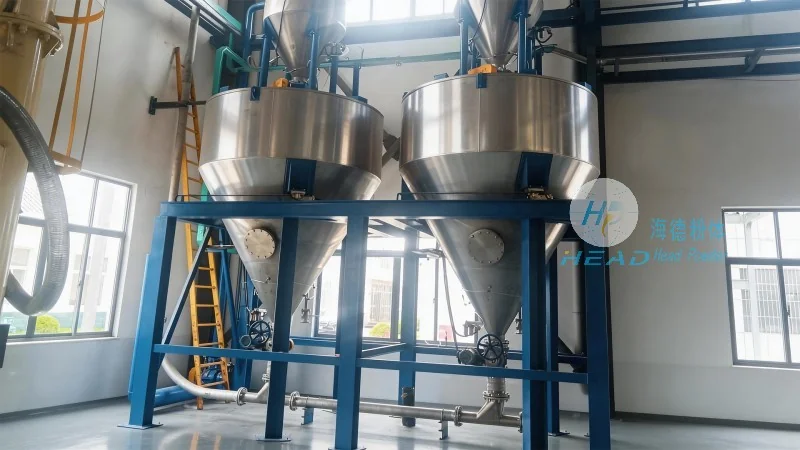
To address the customer pain points mentioned earlier, the Head Powder Activated Carbon Pneumatic Conveying System offers improvement solutions in the following areas:
- Airtight and dust-free, improving the working environment: The system operates in a fully enclosed manner, equipped with high-efficiency dust collectors and dehumidification devices, fundamentally preventing dust leakage, protecting operator health, and meeting environmental emission requirements.
- Anti-blockage and bridge protection design: Uses a fluidized bed sending tank structure, combined with vaporized plates and backflow devices, ensuring thorough fluidization of materials before sending to prevent agglomeration and blockage; The pipeline elbows are designed with wear-resistant thickening to reduce wear risk.
- Low damage conveying: By optimizing the conveying air velocity and material-gas ratio, the collision speed of materials is minimized while contributing to efficiency. Measured activated carbon particle damage rate can be controlled below 2%, effectively preserving the original properties of the material.
- Automated control, stable and reliable:P LC intelligent control system can monitor parameters such as conveying pressure, material level, and flow in real time, automatically adjust conveying rhythm, support remote operation and fault alarms, reduce manual intervention, and support continuous production.
- Moisture-proof and oxidation-proof: The air source is equipped with a refrigerated dryer or adsorption dryer to control the dew point of the gas source, combined with a nitrogen protection option (optional), meeting process scenarios with strict requirements for the stability of activated carbon performance.
Through these measures, Head Powder helps customers achieve efficient, clean, and stable delivery of activated carbon powder, supporting production line automation upgrades and cost reduction and efficiency improvement.