

Pneumatic conveying solution for magnesium oxide
During the processing and use of magnesium oxide, many enterprises face issues such as dust accumulation, material moisture absorption and caking, low conveying efficiency, and high equipment maintenance costs. Traditional mechanical conveying methods not only easily cause environmental pollution but may also cause magnesium oxide to deteriorate by absorbing moisture from the air due to insufficient sealing, affecting subsequent production quality. In addition, the many manual operation steps and low automation further increase labor costs and production risks.
Material characteristics: Properties and conveying requirements of magnesium oxide

Magnesium oxide is a white powder with moderate density and hygroscopic, easily reacting with moisture in the air to form magnesium hydroxide. Its particles are fine, have average flowability, and are prone to dust generation during transportation. It also requires high sealing and moisture resistance for the equipment. Therefore, choosing an appropriate pneumatic conveying solution requires full consideration of its physical characteristics to avoid material loss and quality degradation.
Product Introduction: Magnesium Oxide Pneumatic Conveying System Equipment
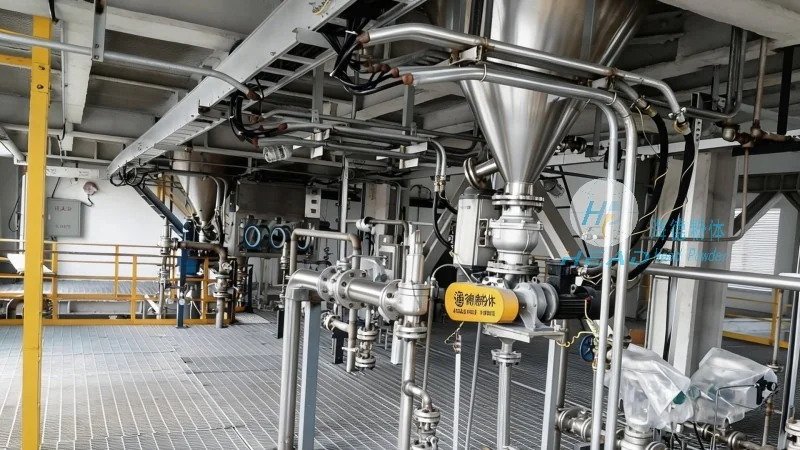
Head Powder specializes in powder engineering, offering customized pneumatic conveying systems tailored to the special properties of magnesium oxide. This system uses sealed pipeline conveying combined with positive or negative pressure power sources, effectively preventing material contact with the outside world, avoiding moisture absorption and pollution. The system is equipped with high-precision feeding devices, pulse dust collectors, automatic control modules, and other core components, enabling fully automated operation from feeding, conveying, and metering to terminal storage.
Product Advantages: Solutions to pain points

- Sealed and moisture-proof design: Fully sealed pipeline and airtight interface prevent material from contacting exposed air, reducing the risk of magnesium oxide moisture absorption and caking, and supporting stable material quality.
- High-efficiency, low-consumption conveying: By optimizing airflow velocity and gas-solid ratio, it reduces energy consumption and pipeline wear, improves conveying efficiency, and decreases equipment maintenance frequency.
- Automated control: Equipped with a PLC intelligent control system, it can monitor conveying pressure, flow, temperature, and other parameters in real time, enabling unmanned operation and reducing manual intervention and operational errors.
- Flexible customization capabilities: Based on customers' on-site space, capacity requirements, and material characteristics, we tailor-make conveying routes, pipe diameters, and power configurations to suit various process scenarios.