

Pneumatic conveying solution for silicone granules
During the processing and transportation of silicone granules, companies often face issues such as dust emissions, material damage, high labor costs, low conveying efficiency, and equipment blockages. Traditional mechanical conveying methods not only easily cause secondary contamination of materials but also struggle to meet complex and ever-changing process requirements. How to achieve safe, clean, and efficient automated conveying has become a core challenge troubling many manufacturers.
Material characteristics

Silicone granules have strong moisture absorption, smooth surfaces, are prone to static electricity, have moderate hardness, and uneven particle sizes. If not handled properly during transportation, particles can easily break, clump, or adhere to the inner wall of the pipeline, affecting system stability and product quality. Therefore, conveying systems need to be specially designed for these characteristics to help maintain material integrity and flowability.
Product Introduction
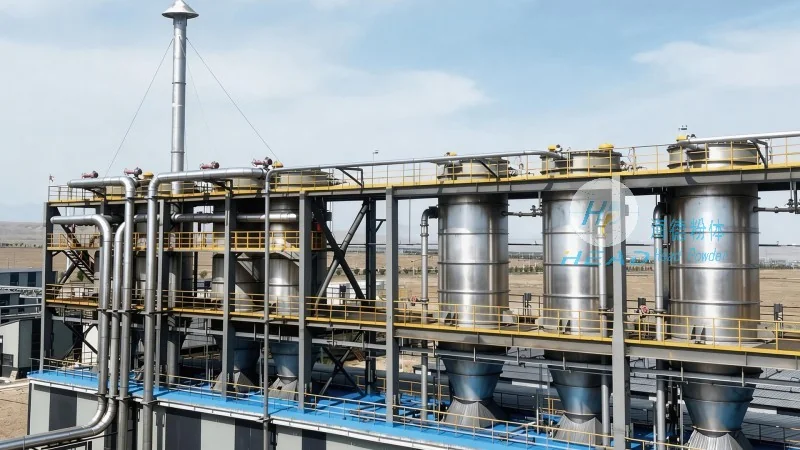
The silicone pneumatic conveying system provided by Head Powder uses a sealed pipeline conveying method, utilizing airflow as the power source to achieve full automation of the material process from feeding to the end of the process. The system can be customized non-standard according to customer site layout, capacity requirements, and material characteristics, covering multiple modes including positive pressure dilute phase, negative pressure dilute phase, and dense phase conveying. The equipment consists of modules such as feeders, pipelines, separators, dust collectors, and control systems. It features a compact structure and stable operation, suitable for industries such as chemical, pharmaceutical, food, and new energy.
Product advantages
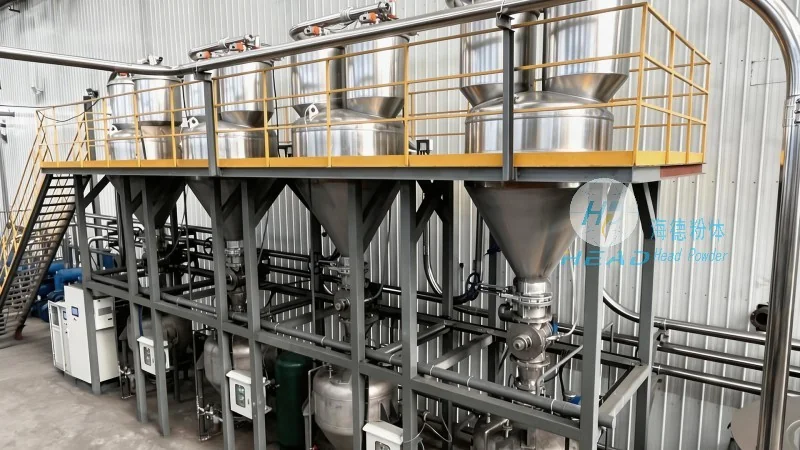
To address customer pain points, Head Powder integrates multiple technical solutions into its system design: adopting low-damage conveying technology, optimizing bend radius and air velocity parameters to keep the particle crushing rate within a reasonable range; Equipped with anti-static and sealed structures to effectively suppress dust leakage and static accumulation; Through the PLC intelligent control system, pressure is monitored in real time for pressure, flow, and material level, enabling fault warning and automatic adjustment, reducing manual intervention; At the same time, the modular design facilitates equipment expansion and maintenance, improving production efficiency and reducing overall operating costs.