

Pneumatic conveying solution for magnesium hydroxide flame retardant powder
During the production and transportation of magnesium hydroxide flame retardant powder, enterprises generally face issues such as material dust accumulation, frequent pipeline blockages, and severe equipment wear. Traditional conveying methods struggle to adapt to the characteristics of large powder fineness and light density, resulting in poor workshop environments, high maintenance costs, and low production efficiency. In addition, the material's tendency to absorb moisture and agglomerate further exacerbates the instability of the conveying system, affecting the continuity of downstream processes.
Material characteristics

Magnesium hydroxide flame retardant powder is a fine powder, with particle sizes typically ranging from 5 to 30 microns, low bulk density (about 0.3-0.6 g/cm³), and poor flowability. Their particle surfaces are polar and easily absorb moisture to form clumps; At the same time, the powder is weakly alkaline and generally corrodes metal pipes in humid environments. These characteristics require the conveying system to be sealed and moisture-proof, wear-resistant and corrosion-resistant, as well as highly effective anti-blockage capabilities.
Product Introduction
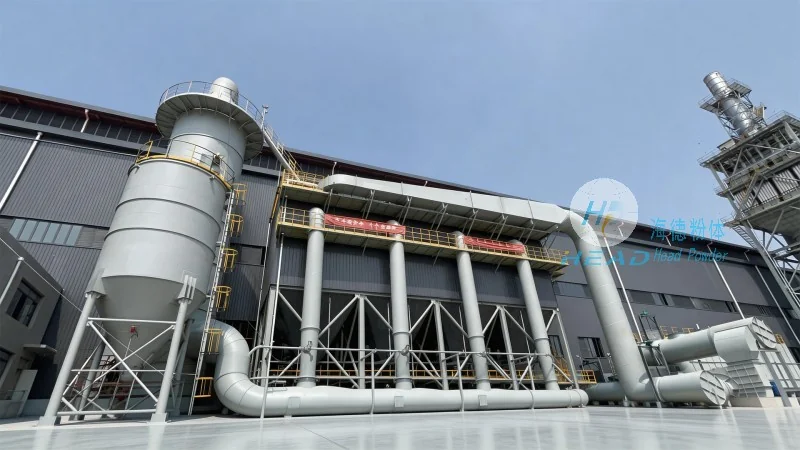
Head Powder provides customized pneumatic conveying system equipment tailored to the physical and chemical properties of magnesium hydroxide flame-retardant powder. The system uses positive or negative pressure dense phase conveying methods, equipped with dedicated feeders, separators, and pipeline components according to material characteristics, achieving efficient and stable powder transport within sealed pipelines. The solution can be personalized based on user capacity, conveying distance, and site layout, helping to control materials throughout the entire process from feeding to use, reducing manual intervention.
Product advantages

To address customer pain points, Head Powder Pneumatic Conveying System offers the following solutions: selecting wear-resistant alloys or ceramic pipes lined with them to reduce wear consumption; Equipped with moisture-proof and airtight devices and arch-breaking flow support equipment to effectively prevent material clumping and pipeline blockages; Adopts low-energy dense phase conveying technology, which improves conveying efficiency while reducing powder breakage; Integrated automation control and weighing modules enable more accurate feeding and real-time monitoring, enhancing overall production line stability and cleanliness.