

PVC pneumatic conveying solution for pellets
During the processing and transportation of PVC pellets, traditional mechanical conveying methods often face issues such as dust pollution, material damage, and high energy consumption. Manual handling is inefficient and insufficiently safe, while conventional pneumatic conveying systems struggle to adapt to the characteristics of PVC particles that tend to stick easily and have poor flowability, leading to pipeline blockages and discontinuous conveyance, seriously affecting production rhythm. Customers urgently need a sealed, efficient, and low-loss conveying solution to address practical challenges such as environmental compliance, frequent equipment maintenance, and capacity bottlenecks.
Material characteristics
PVC pellets are heat-sensitive polymer materials, with particle sizes typically between 1~5mm and densities of about 1.3~1.5g/cm³. They have smooth surfaces but are prone to static electricity generated by friction. Particles are generally elastic and may deform or stick together in high-speed airflow; At the same time, the material easily absorbs moisture, which requires humidity requirements in the conveying environment. These characteristics require the conveying system to have low shear force, anti-static, sealed and moisture-proof, and relatively precise speed control to prevent material degradation or caking.
Product Introduction
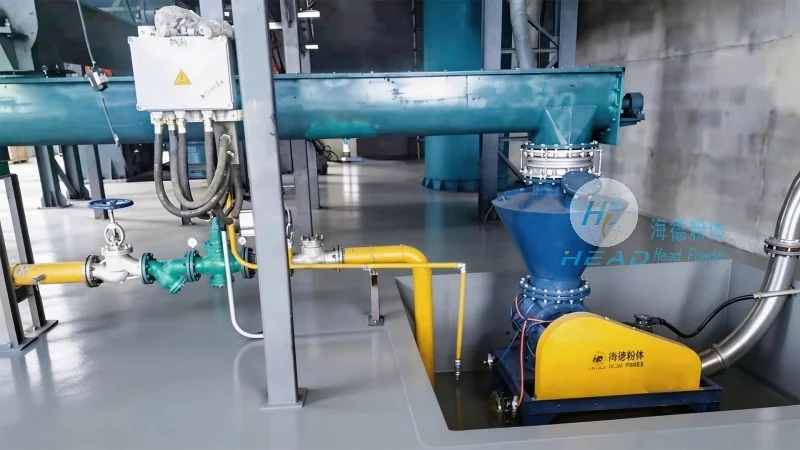
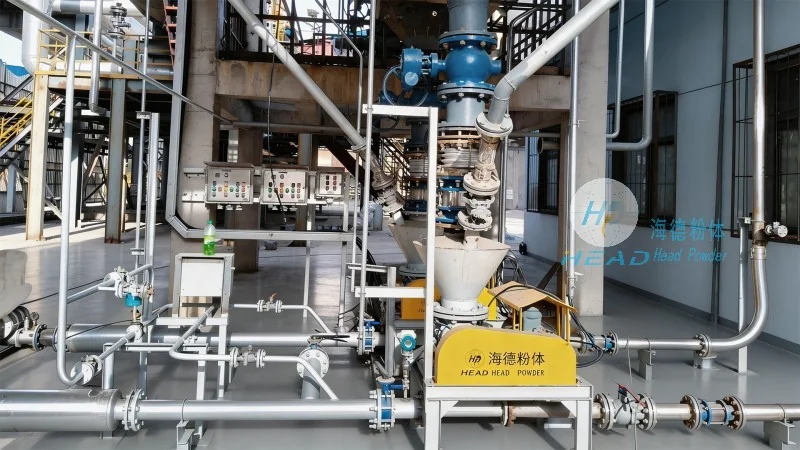
The PVC pneumatic conveying system provided by Head Powder adopts a sealed conveying mode of negative or positive pressure, specifically optimized for the physical properties of PVC pellets. The system consists of a feeding device, conveying pipelines, air supply equipment, dust separation and removal device, and an automatic control system. It can be customized according to the customer's site conditions: conveying distance (10~200 meters), conveying capacity (0.5~20 tons/hour), and pipeline route. Core components are made of wear-resistant, anti-static materials, paired with intelligent variable frequency fans and pneumatic valves to ensure smooth, continuous, and dust-free material delivery.
Product advantages

To address customer pain points, this solution offers the following solutions:
1. Sealed conveying to prevent dust leakage, meet environmental protection requirements, and improve workshop environment;
2. Low speed and low airflow design reduce particle collision and wear, with material breakage rate controlled below 0.5%;
3. Anti-static pipelines and grounding systems eliminate the risk of static accumulation and support safety;
4. The intelligent control system automatically adjusts air pressure and speed according to material characteristics to prevent blockages and improve conveying efficiency;
5. Modular design supports rapid installation and expansion, reducing maintenance costs later.