

Pneumatic conveying solution for lithium iron phosphate powder
In the production of lithium battery cathode materials, the conveying stage of lithium iron phosphate powder often faces challenges such as dust escape, material caking, pipeline wear, and high system energy consumption. Traditional mechanical conveying methods not only easily cause powder moisture and particle size changes, but also lead to poor sealing that deteriorates the working environment, affecting employee health and equipment lifespan. Production continuity, material purity, and energy consumption control have become bottlenecks that enterprises urgently need to overcome.
Material Characteristic Analysis

Lithium iron phosphate powder has the following typical characteristics: relatively fine particle size distribution (D50 usually at 3~10μm), average fluidity, and prone to moisture absorption and agglomeration; At the same time, the material has a medium density, is sensitive to shear force, and exhibits slight abrasiveness. These characteristics require the conveying system to have good sealing, low shear, controllable temperature and humidity, and wear-resistant and pressure-resistant capabilities to prevent material deterioration or pipeline blockages.
Head Powder · Lithium Iron Phosphate Pneumatic Conveying System
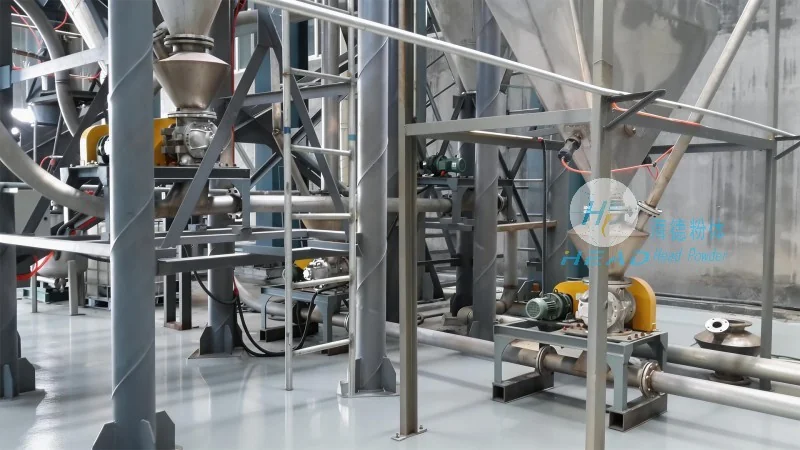
Head Powder offers customized pneumatic conveying solutions tailored to the material characteristics of lithium iron phosphate powder. The system uses positive pressure dense or dilute phase conveying methods, combined with intelligent air source regulation and multi-point discharge control, achieving fully sealed, low-energy, and high-precision powder flow. Core equipment includes high-efficiency feeders, wear-resistant elbows, dust collection devices, and PLC automatic control systems, seamlessly integrating upstream crushing and drying with downstream mixing and packaging processes.
Solutions for pain points

Solving dust leakage:Fully enclosed pipeline design, combined with negative pressure recovery and efficient filtration, eliminates dust leakage at the source and improves the workshop environment.Preventing Caking and Bridging:Utilizes proprietary fluidization and arch-breaking technology, with adjustable gas volume, helping the powder remain loose during conveying.Reducing pipeline wear:Key areas use wear-resistant ceramic linings or large-radius elbows to extend system life and reduce maintenance frequency.Energy saving and relatively accurate control:The variable frequency air source automatically adjusts air pressure and flow according to actual load, reducing energy consumption by 15%~25%; PLC presets formula parameters for remote monitoring and batch traceability.