

Pneumatic conveying solution for ceramic powder
During the production and processing of ceramic powder, enterprises often face numerous challenges in the conveying stage: materials easily generate dust and pollute the environment, severe pipeline wear leading to frequent shutdowns for maintenance, high powder breakage rates affecting finished product quality, and production line interruptions caused by blockages. These pain points not only increase operating costs but also limit improvements in production efficiency.
Material characteristics

Ceramic powders have typical characteristics such as high hardness, high abrasiveness, fragility, strong hygroscopicity, and wide particle distribution. Their bulk density is usually low, their fluidity varies greatly, and some powders are sensitive to moisture. During transportation, strict control of airflow speed and sealing conditions is necessary to avoid particle damage, pipeline wear, and caking issues.
Product Introduction

Head Powder provides customized ceramic powder pneumatic conveying system equipment tailored to the characteristics of the ceramic industry. The system covers multiple conveying modes such as positive pressure dilute phase, positive pressure dense phase, and negative pressure suction transport, and can be customized for non-standard design based on material characteristics, conveying distance, and production capacity requirements. Core components include wear-resistant elbows, sealed rotary valves, high-efficiency separators, and intelligent control cabinets, enabling fully sealed conveying from raw material silos to forming workstations.
Product advantages
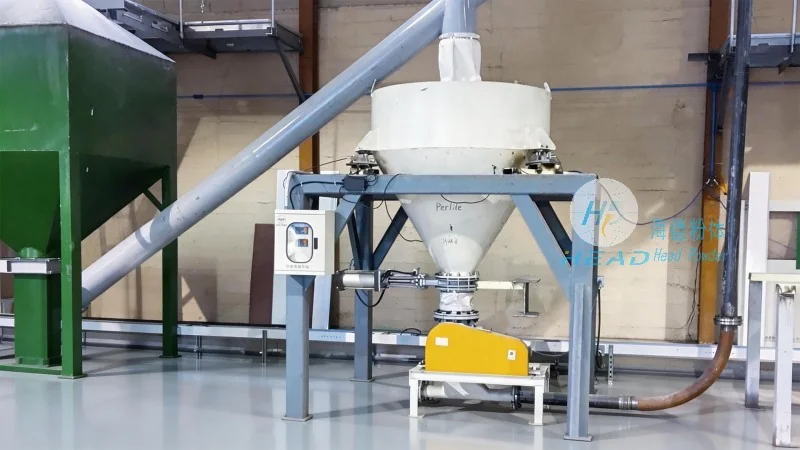
To address customer pain points, Head Powder approaches from multiple dimensions: using ceramic or ultra-wear-resistant alloy pipes lined with cores to reduce wear cycles; Low-speed dense phase conveying technology reduces particle breakage, helping to stabilize powder particle size distribution; The entire system operates under negative pressure or slightly positive pressure, combined with pulse dust collectors to achieve a dust-free working environment; Equipped with a PLC automatic control system to monitor conveying pressure and flow in real time, reducing manual intervention and supporting continuous production reliability.