

Pneumatic conveying scheme for diammonium phosphate
During the production and transportation of diammonium phosphate, enterprises often face challenges such as dust from the material, blockages in transportation pipelines, severe equipment wear, and low manual operational efficiency. Traditional mechanical conveying methods not only lead to high material loss and harsh workshop environments, but also increase maintenance costs and safety hazards. How to achieve sealed, continuous, and low-energy conveying has become a core issue that the industry urgently needs to solve.
Material characteristics
Diammonium phosphate (DAP) is a high-nitrogen and phosphorus-rich granular fertilizer characterized by strong moisture absorption, easy clumping, and high brittleness. Its bulk density is about 0.9~1.1 g/cm³, with a rest angle of about 30~35°. During conveying, it has a relatively high friction coefficient on the pipe wall and is sensitive to temperature, so prolonged high-temperature exposure should be avoided. Therefore, it is recommended that the conveying system have moisture-proof, anti-clogging, and anti-crushing capabilities.
Product Introduction

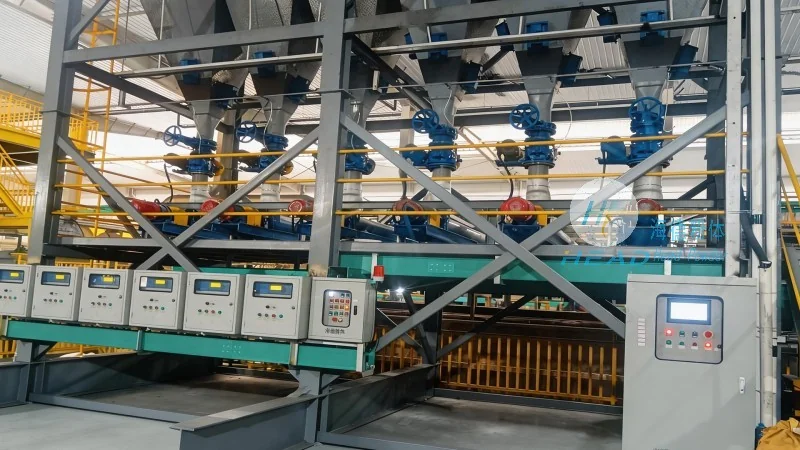
Head Powder's pneumatic conveying solution for diammonium phosphate uses sealed pipelines to transport materials through compressed air or negative pressure airflow, suitable for bulk material loading and unloading, internal workshop transfer, and long-distance conveying. The system consists of a feeding device, conveying pipeline, dust separation and removal device, and control modules. It can be customized according to the customer's factory layout, capacity requirements, and material characteristics to achieve automated and dust-free operations.
Product advantages

To address the pain points of diammonium phosphate being prone to moisture absorption and clogging, this solution uses moisture-proof feeders and stainless steel pipes, with polished inner walls to reduce material adhesion; Equipped with intelligent blockage clearing devices and pressure monitoring systems, it can adjust the air volume in real time to prevent pipeline blockages. At the same time, the low-speed design effectively reduces the particle crushing rate and integrates a high-efficiency baghouse dust collector to help meet emission standards. The system operates stably and maintains long intervals, helping enterprises improve production efficiency and environmental safety.