

Pneumatic conveying solution for soybean pellets
In the processing and storage stages of soybean pellets, traditional conveying methods often face issues such as dust blasts, high material damage rates, low conveying efficiency, and frequent equipment maintenance. Especially since the skin of soybean granules is fragile, mechanical transport can easily cause breakage, affecting subsequent processing quality; At the same time, the dust generated by open conveying not only pollutes the environment but also increases cleaning costs and safety risks. Users urgently need a sealed, efficient, and low-loss conveying solution.
Material characteristics

Soybean grains are oval or round, with a diameter of about 5~10 mm and a bulk density of about 0.7~0.8 t/m³, smooth surfaces, and usually oily content. Its characteristics are fragility, susceptibility to moisture, and average flowability. During pneumatic conveying, airflow speed and curve design must be controlled to prevent particles from colliding and breaking apart; At the same time, moisture-proof treatment should be considered to prevent material clumping and pipeline blockages.
Product Introduction
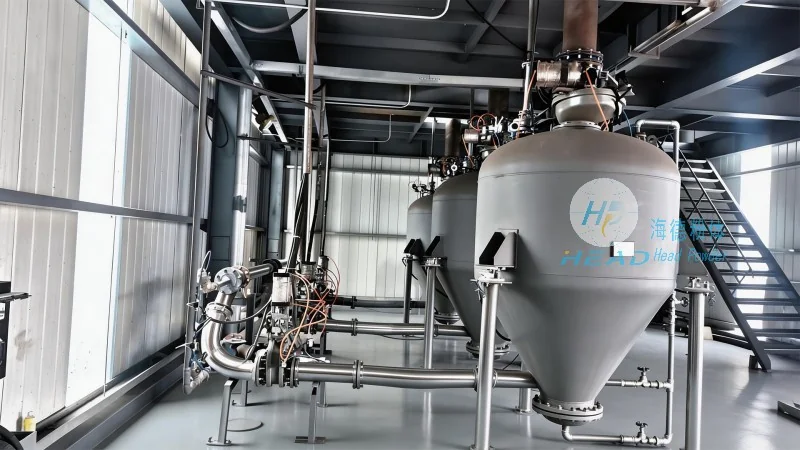
The soybean pneumatic conveying system equipment provided by Head Powder is a sealed pneumatic conveying solution designed specifically for the characteristics of soybean particles. This system uses compressed air or fans as power sources and transports soybean pellets from the feeding point to the storage silo or processing equipment through sealed pipelines, ensuring no dust leakage throughout the process. The system can be customized according to users' site layout, conveying distance, and output requirements, and is equipped with core modules such as rotary feeders, pipeline assemblies, dust separation and removers, and control systems to achieve automated and continuous conveying operations.
Product advantages

To address customer pain points, Head Powder's soybean pellet pneumatic conveying solution offers the following advantages: First, fully sealed conveying effectively prevents dust from dispersing and improves the workshop environment; Second, it adopts a low flow velocity and large pipe diameter design, combined with a gentle elbow and buffer structure, which reduces the impact damage rate of soybean pellets; Third, modular integration enables quick installation and commissioning, and easy maintenance; Fourth, the intelligent control system can monitor conveying pressure, flow, and output in real time, automatically adjust operating parameters, and save energy and reduce consumption. Compared to mechanical conveying, this system reduces energy consumption by more than 15% and is suitable for complex routes with multiple floors and a mix of horizontal and vertical lines.