

Pneumatic conveying solution for anti-static agent powders
Antistatic agent powders often face issues such as static accumulation, dust flying, and clumping blockages during transportation, which seriously affect production safety and efficiency. Traditional conveying methods struggle to balance anti-static requirements with continuous, stable conveying, leading to frequent equipment downtime and increased material loss. Enterprises urgently need a safe, efficient, and sealed conveying solution.
Material characteristics

Antistatic agent powders typically have strong moisture absorption, are prone to static electricity, have a wide particle size distribution, and vary greatly in flowability. Some varieties also contain surfactants, which place high demands on the sealing, explosion-proofing, and material compatibility of conveying equipment. If not handled properly, it can easily lead to dust explosion risks or reduce product quality.
Product Introduction
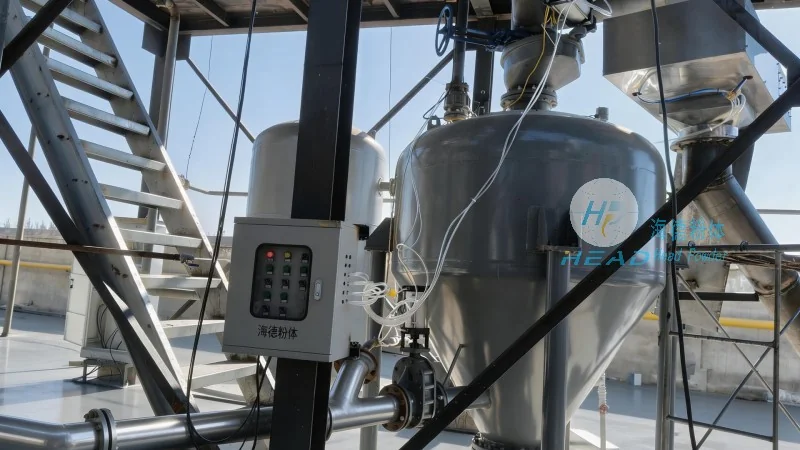
Head Powder has launched an anti-static agent powder pneumatic conveying system, using sealed pipelines for positive or negative pressure conveying, equipped with dedicated anti-static devices and intelligent control systems. The system can be customized for the particle size, humidity, and electrostatic characteristics of different materials, achieving fully sealed, dust-free, and low-loss conveying from feeding to the terminal.
Product advantages

To address customers' core pain points in anti-static, anti-clogging, and environmental protection, the solutions provided by Head Powder support the following: using grounding, anti-static pipeline materials and active static elimination devices to prevent static accumulation at the source; Through airflow adjustment and arch-breaking design, material caking is effectively avoided; Fully sealed operation to prevent dust leakage and meet environmental protection requirements. Additionally, the system can be flexibly configured according to production capacity, enabling one-touch start-stop and automatic monitoring, reducing manual intervention.